After a week in Makemo we shoved off for the next stop on our Tuamotu itinerary, the uninhabited atoll of Tahanea.
Traveling constantly, as we are, there is plenty of opportunity for surprises in our lives. Back in our routine in Kodiak, snuggled into our offices for forty hours a week and sleeping every night in a house that was permanently affixed to a foundation and never moved anywhere, Life had to really put in an effort to throw us a curve ball. But now whenever we pull the hook and point the bow to some other place where we’ve never been before, we have no idea exactly what might be in store for us.
Normally, when we tell stories and say things like, “we had no idea what might be in store for us”, and we talk about life’s surprises, we’re signposting the imminence of something gruesome, or sorrowful, or at least unpleasant. Something momentous, but bad, that will make for a good tale. Human nature being what it is, it’s rare that anything happy and pleasant can hold much narrative power, so it’s an infrequent moment indeed when we can say, “we had no idea…” as an introduction to one of the happier occurrences of life.
Pulling the hook in Makemo, it turned out, was one of these rare moments. And, so. As we prepared to shoot the pass at slack water and sail to Tahanea, we had no idea what lay in store for us.
The fun began as soon as we left the pass on the morning tide and got our sails up. The wind was blowing a steady twenty knots gusting to twenty five and when we made sail our boat speed shot up to seven and a half knots. In land units that’s nine miles an hour, which, for people who are taking a year and a half to get from Alaska to Australia, might as well be Mach 1. The pass on Tahanea was forty nine miles away and we had seven hours until the afternoon slack.
“Damn me,” I said to Alisa, “but we just might make it in one day.”
We put up more sail than we normally would and our speed stayed well above seven knots, at times even hitting eight. I watched the GPS count down the distance to the pass and when each hour had passed we had made exactly seven nautical miles good towards our destination. I got a great feeling of suspense from seeing that we were just on the cusp of making it, and we were excited by the possibility of a night of deep slumber at anchor instead of being hove to off of the atoll, each of us up half the night to watch our location, waiting for the morning slack.
We sailed fast and the waves were big and two of them even broke right over our quarter one after the other, splashing about a foot of water into the cockpit, the first water that we have ever taken there. Elias was strapped into his car seat at the time. “Mess!” he yelled, pointing at the warm saltwater that was slowly draining away.
We made it to the pass just in time to catch the tide and just before the sun was too low in the sky for responsible navigation among the coral. When the sun is low in the sky its light reflects off the water into your eyes and you can’t see coral lurking beneath the surface. After we came through the pass I climbed into the rigging to get the best view down into the water in the bad flat afternoon light. We anchored right next to the pass, feeling like we had pulled something off.
We spent a day in that anchorage. There were three or four other boats and we met a stereotypically jovial French couple and a stereotypically dour Swedish couple. “It’s funny how those national stereotypes can hold”, I said to ‘Lis. The Swedish couple had been to Antarctica in the last Austral summer on their fiberglass boat, no bigger than ours. This brought all kinds of ideas into my head which I am doing my very very best to forget. Then after a day we moved to the southeast corner of the atoll.
Friends, brace yourselves for what you’re about to see.
First, we had a spectacular sail across the flat water of the lagoon, without any chart at all, just navigating around the coral patches by eye:

And after an hour or so of this great sail we found ourselves in a landscape (seascape, skyscape) that looked like this:
 And this:
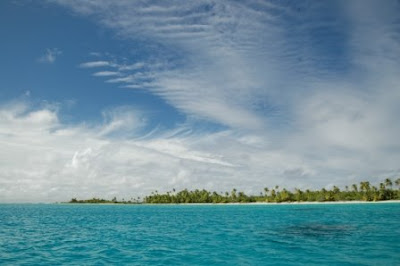 And this:
 Alisa came up with the perfect metaphor that allowed us to capture the beauty of the moment.
“Damn me,” she said. “This is just like the screen savers that people use on their computers at work.”
To give you a little perspective, here’s a composite photo of Tahanea that I found on the web.

The pass that we entered is the central of the three gaps at the top of the picture. Our anchorage at the southeastern end is under the big clouds on the right. What looks like a continuous ring of land in the photo is actually in many places a coral reef awash, separating individual motus. Motu means “island” in eastern Polynesian, and Tuamotu means “many islands”. Tahanea, and all the rest of the Tuamotus, used to be high volcanic islands like the Marquesas are today. Over time the central island has eroded away to nothing, leaving behind only the continually-renewed coral reef that used to circle the land mass. Seeing first the Marquesas and then the Tuamotus on this trip has given me my best insight to how long geological time scales really are. It was nothing but time that turned this:

into this:

Nothing but time enough to strain the bounds of my imagination. I got a strong post-apocalyptic feeling from the Marquesas, where we visited valleys that used to support thousands of people and now support a dozen. But the Tuamotus are post-apocalyptic on a whole other scale: the land is gone, the plant and bird communities are gone, the rivers flow no more to the sea, and only the passes through the
motus mark the places where their mouths once were.
This is the kind of insight that gives you a dangerously realistic perspective on centrally important questions of natural history that should do a lot more to frame our worldview than they actually do. Questions like the age of the earth, and the amount of change that landscapes and living communities continually undergo, and the novelty of our tenancy here.
We settled in and spent the next ten days in that miracle of an anchorage. The diversions that we found for ourselves were many. First of all, there were three endemic landbirds on the motus near the anchorage. We spent our shore time for the first few days getting pictures of these birds, first the atoll fruit dove (
Ptilinopus coralensis):


And then the Tuamotu sandpiper (
Prosobonia cancellatus). This is a critically endangered bird with, according to what Wikipedia has to say about it, less than a thousand individuals extant. The culprits are introduced predators, rats and cats, and habitat destruction for the creation of coconut plantations. Polynesian islands have lost an average of 50-90% of the species of landbirds that were present when the Polynesians first arrived. This is part of a larger pattern, wherein more than 90% of historical extinctions have been of island endemic species, mostly due to the introduction of exotic animals like rats and pigs and cats and goats. I guess there’s a lot that I could say about anthropogenic mass extinction, and the world that my son will inherit when he reaches his majority, and the chance that that world will not include Tuamotu sandpipers. But for now I’ll just share these pictures and note that we had four separate sightings of Tuamotu sandpipers, two of light morph individuals and two of dark morph individuals, including this one here:


We also saw the endemic Tuamotu reed warbler (
Acrocephalus atypha), but we never got great pictures of that one.
The beaches were sandy in places instead of the rough coral beaches that dominate over much of the archipelago, and they were safe and endlessly entertaining for Eli. It was a huge relief for Alisa and me to find a place where we didn’t have to be constantly ready to grab him if he was about to stray into some danger. Each of his hands was occupied with a piece of dead coral or plastic trash as soon as he hit the beach (if you’re familiar with the oceans you know that there is plastic trash
everywhere, on
every beach), and he loved throwing coral chunks into the water.

After we had been taking pictures of birds for a few days we started thinking about the little coral reef next to the beach nearest to
Pelagic. The first day that we rowed by it we remarked that it was probably great snorkeling. Then we forgot all about it for a few days. I finally gave it a try at the end of an afternoon of snorkeling on the scattered coral heads in deeper water. What I found blew my mind. The reef was only in waist-deep water. It was high tide, with about a foot of water over the coral, and there were fish everywhere. I slowly drifted around the edges of the reef and looked out over the top of the coral where feeding drifting darting fish receded into the blue green distance. Alisa and I came back the next day. It was ideal – we could take turns in the water and watching Eli, who was completely content on the beach.
 We brought our field guide to Pacific reef fishes to the beach and we got way into IDing what we saw. The diversity was fantastic – I once saw five different species of butterflyfish in one view. At first we both had a hard time remembering enough distinguishing features to ID anything. We’d come out of the water and look up the white and black striped damsel fish that we had seen and find a dozen possible species in the book. But after a while we got a feel for the bigger taxonomic groups and important diagnostic features and we were able to ID handfuls of new species every time we got wet. It was a great mental game to train ourselves to remember sets of details from particular fish well enough to look them up in the book and not let our impressions get muddled by all the pattern and color, the diversity and similarity of the fish constantly parading before us.
Having an appreciation for biology is a huge plus in a place like this, as it gives you a bit of perspective on what’s really going on in front of your eyes, the taxonomy and ecology and evolution. Over and over I’d say things to Alisa like, “Damn, don’t you just want to live four lives so you can fit everything in? Wouldn’t it be great to do some kind of coral reef ecology study using all these coral patches as replicates? And come to think of it, what was I doing studying cod-shrimp interactions in the Gulf of Alaska, anyway?”
And the diversity of fish communities is only going to increase as we head west in the tropical Pacific.
We had some really unsettled weather, too, days when incredibly forbidding tall black clouds drifted all around us and waterspouts appeared here and there in the distance, snaking from the lagoon surface up into the clouds, and it rained so hard that we just stayed on the boat. But we were glad of the water that we collected from the rain. So we just hung out on the boat and in between showers we let Eli play in the cockpit.
 We also had as many as fifteen remoras (Echeneidae) hanging out on the bottom of the boat at this point, the same fish that attach themselves to big sharks. Eli loved it when we fed them table scraps.


When the rain was over we got some much-needed laundry done, and it was a great indication of how much we had slowed things down that laundry was an event for us, something we were really excited to get done. There was so much rainwater in the skiff that I was able to wash clothes in it, the division between bow and stern serving nicely for separate wash and rinse cycles.

At this point we said, collectively, “What could be better than this?”, and ripped up the list of other atolls that we had planned on visiting.
There were still new
motus to walk around.
 And we found a colony of nesting red-footed boobies (Sula sula).
 Finally we left this heavenly place and moved to an anchorage near Passe D’Otao, the easternmost pass into the lagoon. There is an old village site there, now occupied only seasonally by people cutting copra, and we used water from one of the cisterns to do another round of laundry and get ourselves ready for the big city of Pape’ete.

I went snorkeling in the pass on a flood tide, rowing up into the pass and then jumping in and keeping the dinghy painter around my wrist so that the dinghy drifted with me. And wow. There was at least an order of magnitude more fish than there had been at the little reef at the last anchorage, and also more diversity. I identified three new species of butterfly fish from the dinghy on the way to the pass, before I even got into the water. Actually dropping into the pass was a bit like something from Aldous Huxley. I felt the biological doors of perception swinging open. I was suddenly in a whole universe of life and adaptation and predation and coexistence that was entirely foreign and novel. One of the neat things about coral reef fish is the way they are such poor receptacles to human empathy. There’s nothing cute about them, they’re just very serious and going about their business. So it seems natural that for those of us who, unlike the Polynesians, don’t make a living by eating from the reef, the only way we might understand a coral reef ecosystem is through the mathematical tools of ecology. When you dive on a reef you are suffused with the joy of the living world as it is, in all its complexity and counterintuitive twists of adaptation, but you don’t (or I don’t) feel any temptation to understand what I see in mythical terms, the way some people like to understand, say, bears or wolves.
All that, plus the fish were pretty.
Our visa in French Polynesia was going to last only so long, plus we have several thousand miles still to go before hurricane season begins in November, so we set a day to leave for the two-day sail to Tahiti. Luckily the wind died completely so we got an extra day to spend in Tahanea. A day when we might look out of the portlight and see this:
 A day when the water was so clear that I got vertigo walking around on deck and looking at the bottom forty five feet below. Check it out – you can see the shadows cast by the coral heads and the drag marks of our anchor chain in the sand in the upper left. The floats are to keep most of our chain off the bottom so that it doesn’t snag the coral. When parrotfish swam along we could watch the shadows of their pectoral fins on the bottom.
 It was a day like this:
 The next day we did leave. The world is very big and, practically speaking, we will have to sail around it, or at least all the way around the Pacific, to see Tahanea again. This is the sort of thing that we were thinking of when we named the blog. We might sail for the rest of our lives, but this first year of setting out with a baby and learning the ropes is something rich and vivid that we can only do once. And an experience like the one that we had in Tahanea, when we didn’t know quite what we had in store for us, is something that would be very difficult to replicate.
We shot the pass the next morning under a blustery sky, getting through a little late so that the ebb had built into a race out on the ocean swell that we had to steer to one side to avoid. We turned to the west and unrolled the jib and let it do the work of pulling the boat along, wind and sea behind us. Alisa and I held hands and watched the pass get small behind us, and the seaward sides of the motus spool by.
“You know,” I said, “we’ll always have Tahanea.”
 I got these images at the day’s copra-cutting contest. Teams of three race to be the first to chop open a pile of coconuts, extract all the meat, and bag it up in a burlap sack. Imagine a Polynesian version of the log-rolling contest at an Alaskan fourth of July celebration.


