We did. We really tried to make a life ashore.
We started looking for an apartment to rent. (In Mooloolaba you say that you're going to "rent a unit", but that sounded too ambiguous to us.)
We bought an HD TV and got pre-approved for a loan to buy a new sofa set so we'd be all ready to move in when the right "unit" came along.
But there weren't many smiles to be seen among the crew. We were going through the motions.
Today at lunch we were reading through the classifieds of the local tabloid (headline, and I am NOT making this up: "School Girls in Mobile Phone Porn Snaps Strife, Mum Alleges"), considering our qualifications for the local job market.
It was another perfect winter day. Blue sky, fluffy trade wind-looking clouds, lovely southern breeze.
Alisa looked up from the classifieds.
"What are we doing?" she asked.
I stared at her for a minute, willing my soggy synapses to fire.
"Yeah," I said. "What are we doing?"
So we went through the old routine. We got the cover off the mainsail, and the dingher on deck. The oil has been checked, the decks cleared. We're going sailing!
By the time you read this, we'll once again be happy at sea.
The Atlantic may have the Bermuda Triangle.
But we on Pelagic know that Mooloolaba is really the place for sailors to fear, the place where you might anchor up for the night, and spend a month.
Thursday, August 6, 2009


Wednesday, August 5, 2009
Third Try - Were We Charmed?
The pressure was on for our third and final try to leave Mooloolaba. If we yet again failed at the straightforward task of finding our way to the sea, we would take it as a clear sign that we should give land life a try. We were breathless with the suspense - would the third time be charmed? We were eager to give ourselves every chance to succeed.
We decided that since Alisa and I hadn't had much luck in our previous attempts, we would let Elias steer Pelagic this time around.
Since we live in the era when information is ascendant over thought, we went online to plot our route on Google Earth. And, for a little context on our recent troubles, we also looked up the situation in the Aral Sea region. Because its source rivers have been diverted for irrigation, the Aral has evaporated to the point where it no longer exists. As a result, the fishing fleet has found itself high and dry:
 We figured that if anyone has dealt with the problem of not being able to find their way to the sea, it's the Uzbek fishermen from the shores of the Aral. So we read about some of their colorful folk traditions for finding the sea.
The Uzbeks believe that a captain who cannot find his way to the sea should stand on his head and read about the ocean that he loves.
 I gave it a try with our copy of World Cruising Routes.
Uzbek fishermen further believe that a sea cook who cannot find her way to the sea should wear a fur hat and hold the ship's fire extinguishers to her bosom.
 It took some convincing, but Alisa gave it a try.
After using these colorful folk remedies (which incidentally are completely scoffed at by pediatricians and the drug companies they serve), we felt our spirits reviving. We allowed ourselves to begin to hope that this time we might leave Mooloolaba.
But then, an unforseen twist.
As part of our campaign to blend in with the land-dwelling community, we had each gotten iPhones and used them to overschedule our lives. Just as Alisa was walking up to the bow to pull the anchor, the fur hat still on her head and the extinguishers still cradled to her bosom, I pulled out my iPhone and checked the Little Einstein app that we have started using to keep track of Elias' play dates and cultural enrichment activities. I scrolled through his calendar for the day, past the origami lesson and trigonometry flashcard session, and found this entry in the afternoon: "Party".
"Oh, no," I called out to Alisa, just as she was about to pull the hook. "We can't go today - we've got the party this afternoon!"
 It was an important party: our little boy was turning three!
 He started the day talking to his grandmother - our phone is nestled in his hands there.
 In the afternoon, during the scheduled time, we went to the playground.
 We celebrated over a barbie with the crew from Six Pack.
 Alisa made this great cake. Remember when you were so young that you could fit a candle for each year on top of your cake and have room left over?
 Back on the boat, we marked his height on the compression post.

And he opened presents.
It was a great day, and I think we gave him a good celebration in spite of not knowing any little kids here to invite to the party.
That night, after Elias went to sleep, with the wreckage of decorations and wrapping paper still strewn around the cabin, Alisa and I had a chance to reflect.
"That was it, our third try," Alisa said.
"We didn't make it," I said. "I guess that means we give land life a try."
"I guess so."
~~~
So that's what we're going to do.
Sunday, August 2, 2009
Starting Over
Well, after our two unsuccessful tries at getting away from Mooloolaba, we're taking the time to reassess things. Maybe it's time to start over, to postpone, at least for a while, all our vague plans of sailing, all the possible destinations that we've mentioned to each other: Tasmania, New Zealand, the Cooks (again), Tonga (again), Vanuatu, the Australs, the Tuamotus and Marquesas (both again), Patagonia, Scotland, the Northwest Passage. Maybe too much ambition on our part is a bad thing, maybe a lifetime forever spent chasing the shangri-la just over the horizon would add up to a life of frustration, a life where we can never take our ease and just enjoy the place we find ourselves in at the moment.
Maybe you can go on too long while you're trying to make up your mind about the best time to give up the sailing life. Maybe it's better to take the counsel of apparent signs. Signs like being unable to leave Mooloolaba, in spite of trying twice.
Maybe it's time to start over, to find something else to do with our lives?
~~~
That's a Big Question, and that's the question that we've been mulling over for the last week. Like any other Big Question, it spawns all sorts of ancillary questions. If we don't cruise, will we stay here in Australia? Will we get jobs? Would we still live on Pelagic? Would we stay in Mooloolaba, and get Elias into a day care program here?
We have begun a concerted effort to work our way into the Mooloolaba community, since it appears that we may be here for quite a while. No more for us the attitude of the Sea Gypsy, surveying with condescension the confusion of life ashore from our castle afloat. Time for us to make the best of what may be a bad job and see how well we might fit in with the community here.
Our first step was to enter the Sunday Fun Sail hosted by the Sunshine Coast Yacht Club.
Before we arrived here, I figured that being around yachties would naturally give us entree into Australian society, would give us contacts for jobs and that sort of thing. So far, in practice, being around Australian yachties has largely introduced us to single guys in their 60s who drink every day. But we were ready to renew the effort. And going out on the fun sail meant that we would use Pelagic, well, just to have fun, and not to get anywhere. We could see what that was like - maybe a future of marina living and weekend daysails would be ours.
Plus, we'd be able to follow the other boats out of the harbor, so no more embarrassing episodes of failing to find the exit.
It turned out to be a great day - overcast, with light winds, but still a fine day for a sail. But then, we couldn't find the starting line, or the motor boat that was supposed to be hoisting flags counting down to the start. A worrying sign, considering our recent difficulties with getting lost. Eventually we realized that the noon start must have come and gone. Two obvious groups of sailboats were heading out, away from town. We chose to follow the less flash group. We overtook the slowest of them, asked for directions to the mark we would all turn at, then proceeded to catch up with the rest of the group. We were able to fly the spinnaker the whole way:
 At the mark, we pulled the sock over the spinnaker and gybed. Poor Elias then took the opportunity to demonstrate the perils of being under three on board a sailboat, and banged his lip into one of the extremely hard primary winches. Everything halted while we tended to him. The spinnaker stayed in its sock and we putted along under main alone while the rest of the fleet latered back towards the finish:
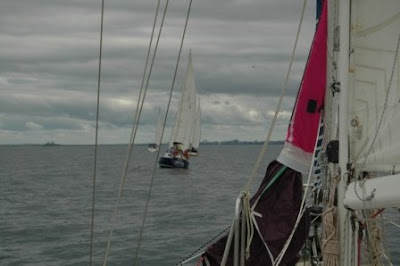 We eventually got the spinnaker going again, and more or less caught up with everyone by the finish, salvaging a fourth place out of a fleet of five or six. The barbecue afterwards was excellent - fun locals, having fun on boats, and not taking the whole thing too seriously.
Maybe you can go on too long while you're trying to make up your mind about the best time to give up the sailing life. Maybe it's better to take the counsel of apparent signs. Signs like being unable to leave Mooloolaba, in spite of trying twice.
Maybe it's time to start over, to find something else to do with our lives?
~~~
That's a Big Question, and that's the question that we've been mulling over for the last week. Like any other Big Question, it spawns all sorts of ancillary questions. If we don't cruise, will we stay here in Australia? Will we get jobs? Would we still live on Pelagic? Would we stay in Mooloolaba, and get Elias into a day care program here?
We have begun a concerted effort to work our way into the Mooloolaba community, since it appears that we may be here for quite a while. No more for us the attitude of the Sea Gypsy, surveying with condescension the confusion of life ashore from our castle afloat. Time for us to make the best of what may be a bad job and see how well we might fit in with the community here.
Our first step was to enter the Sunday Fun Sail hosted by the Sunshine Coast Yacht Club.
Before we arrived here, I figured that being around yachties would naturally give us entree into Australian society, would give us contacts for jobs and that sort of thing. So far, in practice, being around Australian yachties has largely introduced us to single guys in their 60s who drink every day. But we were ready to renew the effort. And going out on the fun sail meant that we would use Pelagic, well, just to have fun, and not to get anywhere. We could see what that was like - maybe a future of marina living and weekend daysails would be ours.
Plus, we'd be able to follow the other boats out of the harbor, so no more embarrassing episodes of failing to find the exit.
It turned out to be a great day - overcast, with light winds, but still a fine day for a sail. But then, we couldn't find the starting line, or the motor boat that was supposed to be hoisting flags counting down to the start. A worrying sign, considering our recent difficulties with getting lost. Eventually we realized that the noon start must have come and gone. Two obvious groups of sailboats were heading out, away from town. We chose to follow the less flash group. We overtook the slowest of them, asked for directions to the mark we would all turn at, then proceeded to catch up with the rest of the group. We were able to fly the spinnaker the whole way:
 At the mark, we pulled the sock over the spinnaker and gybed. Poor Elias then took the opportunity to demonstrate the perils of being under three on board a sailboat, and banged his lip into one of the extremely hard primary winches. Everything halted while we tended to him. The spinnaker stayed in its sock and we putted along under main alone while the rest of the fleet latered back towards the finish:
 We eventually got the spinnaker going again, and more or less caught up with everyone by the finish, salvaging a fourth place out of a fleet of five or six. The barbecue afterwards was excellent - fun locals, having fun on boats, and not taking the whole thing too seriously.
That night, after Elias went to sleep, we talked about buying a slip at the marina, and joining the Sunshine Coast Yacht Club, and giving Mooloolaba a try for a year or two.
"Maybe they're hiring marine biologists at Underwater World," I suggested.
But the next day we caught up with the crew of Six Pack, a 31-footer from Lord Howe Island that recently completed a southern hemisphere circumnavigation. Rex and Louise have been sailing the world for decades aboard a series of small boats, with regular trips back to Lord Howe for work. We met them in Tonga, at the end of their circumnavigation, and meeting up with them in Mooloolaba was the sort of serendipitous event that brings cruising yachts together. It was also good timing, as we had been missing the unassuming company of people who enjoy seeing the world from the deck of their own boat.
We had them over to Pelagic for dinner, and afterwards, excited by their talk of sailing Patagonia, we reassessed the wisdom of staying put.
Talking it over, long into the night, we just couldn't decide what to do.
"Well," Alisa finally said. "Why don't we just try to make it away from Mooloolaba one more time. If we make it, we keep cruising. If we don't, that's three strikes, and we accept our fate and stay here."
And so that's the plan. Tomorrow we try to escape Mooloolaba one more time, and the course of our lives over the next few years hangs in the balance.
Saturday, July 25, 2009
Escape from Mooloolaba II
Well, more news from the accidental sailors on board Pelagic - yesterday we again set out to leave Mooloolaba.
Early in the morning we pulled the hook:
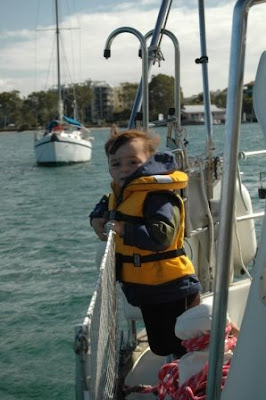 Elias supervised.

 Alisa pulled the anchor and hosed the mud off the anchor chain. Note the winter clothes - time to get back to the tropics!
 "No problem," I said to Alisa. "I must have followed the wrong branch of the river." So I turned Pelagic around and took the next branch we found. Everything looked good, but then we came to another bridge, shown below. Looking at these pictures after the fact, I realized they encapsulate much of what I dislike about Mooloolaba. These are two different bridges, but the boats and houses are so cookie-cutter that at first they look like two pictures of the same scene.
 Alisa looked at me quizzically.
 The last branch we tried was also blocked:
 Shaken, we took refuge in the Mooloolaba Marina, since we had reached the ten-day limit for anchoring in the Mooloolah River. I think there was another reason that we went to the marina - it was bad enough getting lost at sea the last time that we tried to leave, and coming back to Mooloolaba when we thought we were going to Wide Bay Bar. But failing to even find the sea, even by the true-and-tested method of following the river downcurrent, really threw us for a loop. Suddenly our confidence is a little low, and I'm not sure that either of us feels secure at anchor and having to ride the dinghy back and forth from shore. Here's Pelagic in her new home, safe and sound, tied to something that's pretty much guaranteed not to move, and ideally situated so that we can walk on and off the boat:
 Later that night, after the little fellow went to sleep, Alisa and I took our solace in some serious gin and tonics. We read through the logbook entries for the day, reviewing the hourly records of position and conditions as we wended our way through the intricacies of the Mooloolah River system. Everything in the log books checked out - all of the GPS data of lat/long, SOG (Speed Over Ground), COG (Course Over Ground), VMG (I never figured out what that one meant) - it all read properly and error-free. Yet still, there was the insurmountable, inescapable fact of the day - we had failed to find our way to the ocean.
Early in the morning we pulled the hook:
 Elias supervised.
 Alisa pulled the anchor and hosed the mud off the anchor chain. Note the winter clothes - time to get back to the tropics!
Spirits on board were high. The anchor up, we merrily headed downstream, towards the sea, happy to be leaving the Mooloolah River after our longer-than-expected stay. In a few minutes, though, a problem became apparent - this bridge, across the river, barring any further progress downstream:
 "No problem," I said to Alisa. "I must have followed the wrong branch of the river." So I turned Pelagic around and took the next branch we found. Everything looked good, but then we came to another bridge, shown below. Looking at these pictures after the fact, I realized they encapsulate much of what I dislike about Mooloolaba. These are two different bridges, but the boats and houses are so cookie-cutter that at first they look like two pictures of the same scene.
 Alisa looked at me quizzically.
"What's going on?" she asked.
"I don't know," I answered. "We're heading downstream, so we should be heading towards the river mouth. But I don't remember any of these bridges."
We tried another branch, but found another bridge, like the others far too low for us to pass under:
 The last branch we tried was also blocked:
 Shaken, we took refuge in the Mooloolaba Marina, since we had reached the ten-day limit for anchoring in the Mooloolah River. I think there was another reason that we went to the marina - it was bad enough getting lost at sea the last time that we tried to leave, and coming back to Mooloolaba when we thought we were going to Wide Bay Bar. But failing to even find the sea, even by the true-and-tested method of following the river downcurrent, really threw us for a loop. Suddenly our confidence is a little low, and I'm not sure that either of us feels secure at anchor and having to ride the dinghy back and forth from shore. Here's Pelagic in her new home, safe and sound, tied to something that's pretty much guaranteed not to move, and ideally situated so that we can walk on and off the boat:
 Later that night, after the little fellow went to sleep, Alisa and I took our solace in some serious gin and tonics. We read through the logbook entries for the day, reviewing the hourly records of position and conditions as we wended our way through the intricacies of the Mooloolah River system. Everything in the log books checked out - all of the GPS data of lat/long, SOG (Speed Over Ground), COG (Course Over Ground), VMG (I never figured out what that one meant) - it all read properly and error-free. Yet still, there was the insurmountable, inescapable fact of the day - we had failed to find our way to the ocean.
The bottle of tonic water was getting low when Alisa had the Eureka! moment.
"Give me the tide tables!" she said.
And, once she opened the tide book to the correct day, her face was filled with the the Cheshire Cat Grin of being the one to figure it.
"Mike," she said.
"Yes?"
"We followed the river downstream."
"Um. Yes?"
"Well that was the wrong way to go."
"How could it be wrong?"
"Easy. The tide was coming in this morning. So the current was flowing upriver, towards all those bridges."
"Oh, right. Eureka."
So, mystery solved, and our string of embarrassing posts now extends to two in a row. But we figure that, if nothing else, anyone who is out there with dreams of setting off to sail the world on their own boat might learn a cautionary tale from our own experience.
Meanwhile, we still have to leave Mooloolaba.
Wednesday, July 22, 2009
An Experiment, Gone Bad
Well, it's rare that I have something really embarrassing to share. But everyone makes mistakes, and it seems there's no point in sharing the highs of our life afloat if we don't also own up to the lows.
We finally left Mooloolaba two days ago, after being there much longer than we ever expected. It was a calm morning, wind almost nil, and Alisa and Elias relaxed on the foredeck as we motored north. It felt so good to be moving again.
 We passed the Glass House Mountains, named by James Cook in 1770.
 We got to talking about Cook's exploration of this coast. He sailed almost the entire east coast of Oz and narrowly escaped a disastrous end when he discovered the Great Barrier Reef the hard way. We marvelled at the incredible challenge he faced, navigating huge sections of the globe utterly blind, with no charts save those that his expeditions drew as they went.
And then I had an idea.
"We know there aren't any off lying hazards along this section of coast," I said to Alisa. "We're just going north until we reach Wide Bay Bar, which is the first entrance we come to. Why not try navigating by eyeball once, just to see what it's like? It will be our little taste of what sailors like Cook must have experienced. We won't ever have a section of coastline that's easier to navigate than this."
And so that's what we did - turned off the GPS, covered up the compass, put away the charts. We were already a couple miles off shore, with no other vessels in sight, so we even closed our eyes and let the autopilot-less Pelagic steer herself in circles for five minutes. We figured that way we'd begin our experiment on a blank navigational slate, without even a clear idea of which direction we were traveling.

 Closing our eyes at the start of the experiment.
 Things went smoothly enough. A light wind came up, and we were able to sail. The family fell into our comfortable routine of being underway.
 And then, a few hours later, we came upon a harbor entrance, just about when we expected to.
 We dropped the sails and motored into the well-marked harbor. There's something that Cook never found in Australia - red and green markers to show the channel.
We finally left Mooloolaba two days ago, after being there much longer than we ever expected. It was a calm morning, wind almost nil, and Alisa and Elias relaxed on the foredeck as we motored north. It felt so good to be moving again.
 We passed the Glass House Mountains, named by James Cook in 1770.
 We got to talking about Cook's exploration of this coast. He sailed almost the entire east coast of Oz and narrowly escaped a disastrous end when he discovered the Great Barrier Reef the hard way. We marvelled at the incredible challenge he faced, navigating huge sections of the globe utterly blind, with no charts save those that his expeditions drew as they went.
And then I had an idea.
"We know there aren't any off lying hazards along this section of coast," I said to Alisa. "We're just going north until we reach Wide Bay Bar, which is the first entrance we come to. Why not try navigating by eyeball once, just to see what it's like? It will be our little taste of what sailors like Cook must have experienced. We won't ever have a section of coastline that's easier to navigate than this."
And so that's what we did - turned off the GPS, covered up the compass, put away the charts. We were already a couple miles off shore, with no other vessels in sight, so we even closed our eyes and let the autopilot-less Pelagic steer herself in circles for five minutes. We figured that way we'd begin our experiment on a blank navigational slate, without even a clear idea of which direction we were traveling.
 Closing our eyes at the start of the experiment.
 Things went smoothly enough. A light wind came up, and we were able to sail. The family fell into our comfortable routine of being underway.
 And then, a few hours later, we came upon a harbor entrance, just about when we expected to.
 We dropped the sails and motored into the well-marked harbor. There's something that Cook never found in Australia - red and green markers to show the channel.
As we motored in, Alisa and I both started getting nervous. This harbor didn't look anything like what we remembered of Wide Bay Bar and the nearest town, Tin Can Bay. Those places were pretty sleepy, but the place where we found ourselves now was built up, with condos, a fleet of docked commercial fishing boats and a marina full of recreational boats. Something wasn't quite right...
And then it clicked - we were back in Mooloolaba!
When we opened our eyes and started following the coast at the start of the experiment, we had inadvertently begun following the coast south, back towards Mooloolaba, instead of north to Wide Bay Bar. What should have tipped us off was that the coast was on our starboard side (see the second-to-last photo), when it should have been on our port.
Kind of embarrassing, really, and to be honest we thought long and hard about whether we should share this experience on the blog or not. But we figured that we don't really have anything to prove, and anyone can make a mistake, so there's really nothing to be ashamed about.
After successfully finding our way across the Pacific, accurately making landfall after landfall, we finally goofed one up.
At least we renewed our respect for the achievements of Captain Cook...
But now we have to leave Mooloolaba again.
Friday, July 17, 2009
We're Back!
Well, the blog starved while we were away in North America, but now we're back in Oz, and back in our own life, and the postings will resume their earlier pace.
We found Pelagic in great shape after sitting for seven weeks unattended at someone's dock in Mooloolaba. We've re-entered the emotionally close lifestyle that we get to enjoy as the result of living in a little space with a Little Person, without the saving grace of a door to close behind ourselves every now and again. And finally, finally, we're starting the trip north to the Great Barrier Reef tomorrow.
I admit that I felt a little trepidation as we returned to Oz. Keeping everything going on the boat is such an unending struggle, and it's a little weird to be sitting on the anchor so much lately instead of sailing across an ocean, and the part of Queensland we've been in is so unappealing.
But it's been great to be on the boat again. And I've noticed that even in soulless Mooloolaba the sky is much more dramatic than in the U.S., and the light is much more beautiful. I think it must be because the air is cleaner in the southern hemisphere.
Our trip back to the States was all about seeing family, and we had a GREAT time doing that. But apart from the family visit, I also had a few neat insights during our time in the Lower 48. One was how nice it was to occasionally hear Alisa blurt out, "This place sucks!" as we were driving around some sprawled-out, generic town where the public space was dominated by the same corporate edifices that you find everywhere else in America. Usually I'm the one who voices strong opinions about things like that, so it was nice to let her say how ugly and pointless were some of the places where we found ourselves (no offense to our loved ones who might live in those places). Disagreement over what constitutes a good place to live can be one of the hardest things in a marriage, and I'm happy that Alisa and I seem to be in such perfect agreement on that score.
Another neat insight was the way that people tend to aggregate with others of their ilk in particular places. For instance, American men with bad toupees seem to gather in airports. And Put-in-Bay, Ohio, a little town on an island in Lake Erie where we spent a delightful day with Alisa's fam, attracts fat people. I had gotten used to thinking of Australians as being a little chubby and out of shape, but that's nothing compared to how big an average American on summer vacation at Put-in-Bay can be. No offense to anyone, of course, but I started wondering about the implications for the future of the nation - as people get less healthy, they work less during a lifetime, and their health care becomes more expensive, and it all has to add up somewhere...
I recently read an article about how American parents no longer teach their little kids nursery rhymes, but instead teach them pop songs and TV theme songs and advertising songs. When I read the article I thought that change sounded like the natural outcome of change in the society, and not necessarily a bad thing. But (neat insight!) seeing the cultural diet of some American kids for myself changed my mind. I came up with the phrase "culturally polluted" to describe the phemomenon of little kids who are full of age-innapropriate pop art. Again, no offense to anyone whose five year old might know the words to "Gin and Juice", and I'm sure they'll all turn out to be happy, productive adults. But the little kids that we know in Iluka are so innocent by comparison. And that innocence seems so important.
Hmmm. There were some other neat insights, but I guess the gist of them is that after seven weeks of house-living back in the home country, I'm really really glad that we're sailing now, at the prime of our lives, and not still dreaming about it.
(More of) why we love Alaska
Here are a few pics of our now not-so-recent trip back to the Great Land to illustrate some of the reasons we love that place so much...
I'll begin with some shots taken 20 minutes outside of Anchorage, the biggest, most disgusting city in Alaska. We've stopped to picnic at a creek where people are dipnetting little fish called eulachon (pronounced "hooligan" by those who dipnet for them). Eulachon are off the charts in terms of oil content, and some people love 'em. Could you find such a cool scene 20 minutes outside of the biggest, most disgusting city in any of the other states?
 The eulachon were running heavy, and people were averaging ten or so fish per scoop. Elias charmed this nice old couple, who kindly gave us a gallon bag full.
 Eulachon! We fried them for dinner that night.
 Here's our picnic spot. We're at the head of Turnagain Arm, first explored for the Western world by James Cook, who is also known for some exploration he did in the Southern Hemisphere. In Alaska, this is what we consider over-crowded country, too close to the road to be any good any more.
 We were picnicking with our good friend Ann, and her new husband Dustin, whom we had never met before. Turns out he's a stellar guy.
 We spent a few days with Ann and Dustin and other friends (Paul and Kim and Shiway) in Hope, Alaska, a little town Alisa and I had never been to before. It was much warmer here than it had been in Kodiak at the start of our trip (no surprise), warm enough to enjoy ice cream. This may be Elias' first-ever ice cream cone, though opinions on that point differ.
 Ann and Alisa dishing - talking some serious talk - over breakfast and over Elias. The little house that we rented in Hope was great, and we took a couple of great hikes along Turnagain Arm. But, as always, the real magic of Alaska was in the people, more than the place.
Subscribe to:
Posts (Atom)


