We're onto Twice In A Lifetime!

We've got a new boat and a new blog (and a new kid!). Catch up at Twice In A Lifetime.

Friday, December 14, 2007

Leg Two

From Morro Bay our plan is to sail strait through to San Diego.

Here is the barky, at low tide, ready to go to sea.


A few hours out we come across whales. The first notice I have of them is a trumpet blow off to starboard, a distinct B-flat with a lot of lung behind it. I look up and see the column of mist that the whale has left, then another and another. The whales start to lobtail and breach. Far away, but the telephoto lets me get decent pictures as we sail away from them at five knots. I think they’re humpbacks, though I’m not sure that humpbacks have such falcate dorsal fins.

These are two separate series of pictures.


After they’re gone I go below and smell whale breath through the open portlight in the head. Whale breath is invariably reported as foul, but from this great distance it smells faintly, and not unpleasantly, of pickles.

An exhausting night follows. Sails up and down, wind all over the place. Dodging ships across the Santa Barbara channel, their huge close shapes making me feel physical fear. The wind comes up to the low twenties around Point Conception, where we charge back to the north for half an hour to stay out of a ship’s path. Sailing upwind towards three oil rigs, I smell them clearly in the dark – like a book of matches that has been lit all at once and then soaked in water.

Alisa wakes up at 0100, but ships and sails need attention, so I stay on watch. After we cross the shipping lanes and pass San Miguel Island I struggle with the spinnaker pole in the dark, then struggle to get the autopilot to steer the unbalanced boat. Bugger.

I finally go down to the bunk with a course set to take us south of the Channel Islands. We’ll cross the Pacific Missile Test Range, which is marked on the chart, but we haven’t heard any training activity announced on the VHF. The range is not closed to navigation, so I figure all is fine. The Navy group that announces training activities in the area is called “plead control”. God knows why, but the name certainly suggests a hierarchy in the relationship between us and them. Whatever the case, plead control comes on the air two hours after I go to sleep, announcing “live fire exercises”. Commencing immediately. And directly in our path.

The wind has dropped again, so that we’re barely making headway under poled-out jib, and we won’t reach the training area for hours. I sleep briefly, then wake at dawn. The VHF is broadcasting an advisory for Santa Anna winds ashore, so now we have both the missile range and these strong northerly winds to consider. Our cruising guide warns us of the danger of Santa Annas, but I can’t get the marine forecast to find out what might be coming. We’re on a flat sea, the sail flapping in almost no wind, with San Miguel Island to port, three different shades of brown, bare and sandy. I try to form a plan. Everything in my head is slow with too little sleep. I make a mental list of things to do. Get jib in. Get pole down. Plot position. Get marine weather. Consult Coast Pilot and cruising guide for a suitable anchorage. I repeat the list to myself, again and again. Then I slowly begin working on one item and another.

We motor north through the Channel Islands towards Santa Barbara and away from the missile range, since the islands offer no obvious southern anchorages where we can hide from the Santa Annas. Alisa and Elias wake up and our day at sea begins. We cross the shipping lanes of the Santa Barbara channel again. I finally get a marine forecast on the sat phone and nothing more than NE 15-25 is called for. With relief we point the barky south. Neither of us wanted to go to Santa Barbara.


We pass three more oil rigs in the Channel. Like elephants, breathing fire from the tips of their snouts. Night finds us in the eastern part of the Channel, with dolphins riding our bow. I go forward and shine a flashlight into the water. The dolphins glow a pearly grey in the flashlight’s beam, like the souls of dead things trapped beneath the black water.

We pass L.A. in the early hours. Fog lies low over the water, so we see little evidence of the sprawling city. Planes hang in approach patterns over the airport, making stately strings of light in the sky.

At dawn we cross the shipping lanes south of L.A. Here's a tanker passing us to port. It’s all easier in daylight.


These southern waters are strangely empty. We see exactly one other sailboat between Morro Bay and San Diego. We make the nighttime entrance to Mission Bay, just north of San Diego, picking our way through crab pot buoys in the dark. And the next morning we motor the five miles south to San Diego. A blanket of smog greets us at the entrance.


And then we have this view of the city.


When we set off from Kodiak we had the early parts of our trip broken into two legs; one east-west leg that would get us to Haines, at the top of Southeast Alaska, and a long north-south leg that would bring us the length of the U.S. and Canadian coastlines, from Haines all the way to San Diego. So that second leg is finished, and we’re on the cusp of leg three, which will take us the length of Baja and into the Sea of Cortez.

We’re tied to the transient dock at the Harbor Police building, visiting family and getting things ready for our year of sailing the barky from the U.S. to Oz. This final stop in the U.S. gives me a chance to reflect on how much living we’ve packed into the last six months. Everything north of San Francisco seems like it happened to someone else, and Alaska seems like a different world. Back home we’d be skiing, and enjoying the round of seasons, and saying how quickly the fall went. Here time expands, it slows, and our constant exposure to new situations and lack of a set routine keeps us from glossing over the world and letting time, and life, pass us by.


Postscript:


I wrote the above entry a week ago, and we've now been in San Diego for more than two weeks. Aside from some visiting with family and socializing with a few friends we've been working that whole time, working as fast as two people trying to keep a one year old out of trouble on a yacht can work. We've pulled the autopilot drive for service, taken the injectors out of the diesel and put them back in, installed a new GPS, got the watermaker replumbed and working, been up the mast to retrieve faulty wind instruments, figured out how to retrieve weather charts from the ham radio, bought a huge array of spares and supplies for every system on board, and figured out all the arrangements for international travel: visas, insurance, health precautions, etc., etc. We are both a bit fried from the frenzy of doing all this while caring for Eli in the confined space of the barky. It's impossible to convey how slow things get when you're living on board with a baby and trying to work on the boat. When we began to see the bottom of the job list a few days ago Alisa said, "After all this work we're putting into getting the boat right, you know we're going to want to sail for more than a year."


We're ready for some stone-kickin' it time, maybe even a few of those Transcendent Moments that cruising is supposed to be good for. We had planned on getting some welding done in Ensenada, but are now planning on putting it off for La Paz and just enjoying the west coast of Baja without (we trust) too much boat work.


We'll be leaving the country for an indeterminate length of time when we motor out of San Diego Bay. I remember how visiting Ethiopia and Yemen twelve years ago gave me a fresh appreciation for the U.S., and I wonder if this stint away will have the same effect. San Diego, and much of our tour of the West Coast, have confirmed the worst of my opinions about the current state of affairs in the Lower 48. Maybe the wonders of Rapa, one of the strangest islands in the South Pacific, will be my solace. Or maybe it will be those spells at anchor when we row Elias ashore to the beach every day, and those weeks at sea in the trade winds, when we feel the peace that comes to people who sail out of sight of land in small boats.

Monday, November 26, 2007

Morro Bay

The day after Thanksgiving we arrived in Morro Bay. Rather than arrive in the dark, always a non-non for unfamiliar harbors and particularly so for this potentially dangerous entrance, we pulled down the sails at drifted for half the night. No wind, no swell, and incredibly serene with Alisa and Elias sleeping and the red night lights half-illuminating the cabin. The next morning we pulled in past Morro Rock, seen below.


Once in Morro Bay we reunited with our friend Becka, who lives in the little beach town of Cayucos just up the coast. We worked with Becka in the field in Kachemak Bay in 1999, back in our days of seabird and forage fish biology. We met her husband, Mike, and son, Otis, and a whole bunch of their friends in Cayucos. And, highlight of highlight, Mike and Becka took us surfing.


Becka showing Otis a helicopter.

Elias and Otis, modeling two approaches to beach fashion.
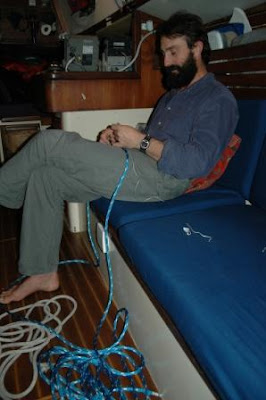


We're planning on leaving tomorrow, bound for San Diego. I had a strong image this morning of how much further down the coast we would have been if not for the daily mix of childcare and cruising, of how efficient and rapid we would be as just two adults afloat. On the other hand, if we'd stayed at home with Eli and put off cruising for the future, we'd be way behind where we are now. It's all good.


Here are a few Alameda shots, just to illustrate some of the jobs we were crossing off before we left.

Whipping new running rigging.

Reinstalling the repaired Monitor windvane, using the brand-new DeWalt cordless. Feel the power!

Installing the automatic tuner for the new ham radio in the cockpit locker.

Returning from the grocery store, well burdened with provisions.

Elias just clowned around.

Thanksgiving 2007

Two hours after dawn, a ship. All night we have made a meal of the light northerly breeze, traveling south at four and even five knots as the sails flap themselves empty with the roll of each swell. Now we are just at the edge of profitable sailing, making two knots on the last puffs of this wind. Both sails are boomed or poled out and lashed fore and aft to hold them in place before the wind. Pelagic is spread-eagled in her least maneuverable point of sail while the ship draws closer. It is the color of a brick, and has all the solidity of ten million bricks in a place where everything else in fluid. Barely moving and barely maneuverable, we are in the way.

Alisa comes up to the cockpit, cross after standing watch half the night, and we jibe. After ten minutes the ship is closer and I realize we have jibed into its path. I jibe us again, towards the ship’s stern, and watch it slide past us, its massive bow wave clearly visible from a mile and a half away.

An hour later another ship comes along, then another. We realize that the ships are cutting the corner around Pt. Sur, which brings them in about 17 miles from land, close enough to cross our path. So we pull down the sails and motor in towards the coast to be free of them.

We close on the Big Sur coastline, brown hazy mountains coming strait out of the water, a place where few roads make it to the ocean. Four brown pelicans fly by us, perfectly imitating pterodactyls as they glide low over the water and occasionally flap their wings, one bird at a time. Last night was bitterly cold, too cold for bare feet, so cold that around midnight I retreated from the cockpit to the chart table below, and only came up every ten minutes for a look around. But now the sun is on the flat sea like beaten copper and I’m in shorts. Pt. Conception, still 150 miles south of us, is meant to be the division between the northern and southern California coasts, but with the pelicans and the strangely naked mountains behind the haze, it feels like we’re south now.


Alisa, meanwhile, has been rising to the occasion in the galley. At 1400 all hands gather for an onboard feast of yams, cranberry chutney, her famous mashed potatoes and Chilkat River sockeye salmon. We all have double helpings, including Elias, and Alisa and I inventory our causes for thankfulness, concentrating on the few and profound, rather than the many.

Wednesday, November 21, 2007

Gone

Well, finally, this is it for us and Alameda. For the last week we've been at the Encinal Yacht Club, where we first tied up when arriving in Alameda more than a month ago. We had no idea at the time that we'd be here so long, but it's been a good base for us to get necessary work done on the boat. And now we're ready to be done with that pragmatic approach to cruising, and ready for some fun, maybe even a little of that old romantic life afloat sort of thing. (Our friend Elie says, "Romantic? Our boats are too complicated, we don't have time for anything romantic." Sounds great in his French accent.)

The weather forecast is great for the next few days, north winds 15-25 knots. We plan to fuel up and anchor the night off Sausalito, then head out the Golden Gate tomorrow morning.

Reading "Lucky Jim", by Kingsley Amis. Brilliant written comedy, great depiction of individual pathos in the early modern age. Also a great contrast with Evelyn Waugh's "Sword of Honour" trilogy in terms of the development of English society through and after World War II.

Came across a passage in there that very well illustrates the Once in a Lifetime theme:

"...here he was, quite able to fufil his role, and, as with other roles, the longer you played it the better the chance you had of playing it again. Doing what you wanted to do was the only training, and the only preliminary, needed for doing more of what you wanted to do."

Saturday, November 17, 2007

Walkin’


Elias began walking two and a half weeks ago. Baby’s first step is of course supposed to be one of the special moments in parenthood, and Elias’ lived up to those expectations and exceeded them. It was like hearing for years about how spectacular Geographic Harbor is, then going there and finding that the descriptions you’ve heard don’t do it justice. He started walking one day at the housesit in Berkeley, and when I got back from the boatyard he was trotting in circles around the ottoman, holding on with one hand to keep his balance. Every now and then he launched out into open space towards Alisa, who was kneeling two or three baby steps away. His walking was really just a controlled crash, as he managed to totter on his unsteady legs for a moment before collapsing into Alisa. The redeeming part was the pure joy Elias was expressing, the huge smile that filled his face and the giggly laughter as he tried his new trick over and over, his little body overflowing with the excitement of what he could do, his head thrown back in a good imitation of ecstasy after every crash into his mother’s arms. What fun.

For the first week or so he walked just like an orangutan, with both hands held out front, up high over his head for balance. He’s still very unsteady, and has collected a prime series of bruises from his various encounters with fixed objects, most notably the floor. Our boy seems to lead with his head. Notice the cut temple and rug burn around the eye in the picture above.

Still in Alameda, but getting close to leaving. Throwing down for a new ham radio today, having decided that the Kenwood that came with Pelagic is too geriatric to make the trip. Mounted the Monitor windvane on the stern yesterday, fresh back from the shop with a bunch of new welds, two new diagonal cross braces and a new pinion gear. The people at the shop were very helpful, throwing in used parts and factory seconds at no charge, and this most useful of all optional devices on the boat is strong and (hopefully) ready for another 17 years of steering Pelagic.

Saturday, November 10, 2007

Map of the Trip Thus Far

Go ahead and pan and zoom - the level of detail is incredible!

Also, the map let us calculate the length of our voyage so far - looks like we have covered about 2,800 nautical miles.


View Larger Map

Wednesday, November 7, 2007

Always Getting Ready

Always Getting Ready is the title of a book about Yup’ik Eskimos on the Yukon-Kuskokwim Delta in southwest Alaska. A Yup’ik woman interviewed for the book talks about how people in her village are always getting ready for the next subsistence activity – hunting birds, or picking berries, or catching salmon, or shooting beluga whales. I’ve never read that book, but the title describes the endless work and round of seasons of traditional Alaskan economies so well that the phrase has stayed with me. And it is a phrase that also describes our new sailing life well.

After Aquatic Park we motored across San Francisco Bay to Alameda. We got great views of the City from the water, and traveled under the Bay Bridge, which is in the background below.


San Francisco Bay is incredibly small (the main part of it, anyway, barring the estuaries and rivers that branch off in different directions). It’s only a few miles from San Francisco to Oakland and Alameda. The entrance to the ditch separating those two cities hosts a big container-loading facility, seen below. As we drive borrowed cars around the East Bay those cranes make a great landmark, and Alisa and I are quietly treasuring the expectation of the day when we’ll motor past them on the way out of Alameda.


Many of the containers loaded by these cranes arrive or leave the port on trains, and one of the very best parts of Alameda for me is the sound of the train whistles blowing in the yards across the ditch in Oakland. We hear them at night when we’re lying in our bunk. Normally when you hear train whistles they’re doppler-shifted by the velocity of the train, and there’s only the one whistle, disappearing into the distance and sounding lonely. But the trains in Oakland aren’t moving fast, and there’s a lot of them, so their whistles sound conversational and friendly. I love it.

Can’t say I love much else about the East Bay. Our time here has made us both lonesome for Alaska, and a bit shocked at the life that so many people put up with in the Lower 48. The aesthetics of the landscape in Berkeley-Oakland-Alameda are just disastrous, and the filthy air and freeway-centered lifestyle are too grim for words. This is a place where people commune with nature by buying shampoo containing botanicals and algae extracts from upscale grocery stores that are so crowded that you literally get shopping cart traffic jams. The East Bay is, in a nutshell, a poxy shitehole. (I’ve just read Trainspotting.) No offence to the wonderful people who live here.

On a brighter note, we have reunited with Elie and Marie in Alameda, friends who we met when they spent the winter in Kodiak on their sailboat. Now they have a new boat, and a new crewmember, four year old Jules. They have been living in Alameda for those four years, saving up money and getting their boat ready to cruise for the next 20 years. Elie and Marie are very experienced sailors who have had fine adventures in remote places in the Pacific, and I find talking with them to be wonderfully reassuring and informative. As opposed to all the marina experts whom we’ve met in California, Elie and Marie have embraced cruising as their life, and they have a frugal and realistic take on cruising that really contrasts with the spend-another-grand-at-West-Marine approach that we more often encounter.

We spent a few days tied up at the docks of two yacht clubs in Alameda, where we met some very friendly people, and then we made the decision to haul out here, instead of waiting for San Diego or Ensenada. We were helped out by a timely housesit for my sister’s good friends Jen and Ben in Berkeley, so we could tear the boat apart without keeping it baby-proofed for Eli. And tear it apart we did, getting after both routine maintenance and some pesky problems that we didn’t want to deal with in Kodiak, where getting sailboat supplies is so hard. Here are pictures of me painting the sheer stripe, Alisa greasing winches, and the interior of the poor boat in mega-project mode.


We were in the yard for twelve days, working hard every one of those days. What a joy to finally launch. We’ve got those twelve days of work behind us, but there are still plenty of jobs that we’d like to cross off the list before we leave the country. That’s where the “Always Getting Ready” part comes in. The topic of boat maintenance is the dread curse of writing about the sailing life. No one can make stories of fiberglassing rudders or replacing bilge pump hoses entertaining. But again and again people living on sailboats who fancy themselves writers decide to go on about these topics, falsely assuming that others will find their boat projects interesting. I have manfully resisted the temptation to write about maintaining the barky on this blog. But now, since we’ve just hauled out and are in the midst of an avalanche of in-the-water jobs, I will indulge myself briefly.

And so, in brief. We have put a crushing amount of work into Pelagic during the four years we’ve owned the boat. A truly overwhelming amount of work. This is a normal state of affairs for anyone going cruising on a budget. So while we’re lucky to be doing this trip, as lucky as anyone is who can chuck it all for a few years and savor a life lived at sailing speed, please don’t think that it’s just luck that has gotten us, or any other cruisers, to the point of casting off the lines and heading out for a year or three. There’s luck involved, and the ability to organize your life around a vision, but also more work than many of our contemporaries can imagine.

Things on boats are always breaking. That’s a normal state of affairs, and as boats have become more complex, the number of things that can break has increased. As we sailed down the west coast, Alisa and I kept a list of boat jobs that we’d like to get done before we leave the ready availability of parts in the U.S. and begin our trip across the Pacific. The list runs to 80 jobs. We’ve put all that work into Pelagic over the last four years, and we’re still not ready. We plan on another slug of boat work in San Francisco Bay, then another in San Diego, and another in Ensenada. Then, hopefully, we’ll have the boat at a level of readiness that will allow us to drop back to say, 20 hours of maintenance work a week as we sail down the Mexican coast and across the South Pacific.

We’re both pretty tired of being in Alameda, and we suspect that we’ll like San Diego, our one other chance at the services of a major city before we leave the U.S., even less.

We’re getting very excited for Mexico, and the delights of the South Pacific beyond, and realize that we are again reaching a point, just like the one we reached when leaving Kodiak, where we’ll have to work hard to get ready and then just leave, regardless of what jobs are or are not done.